Editorial first look · Specifications checked 19 October 2026
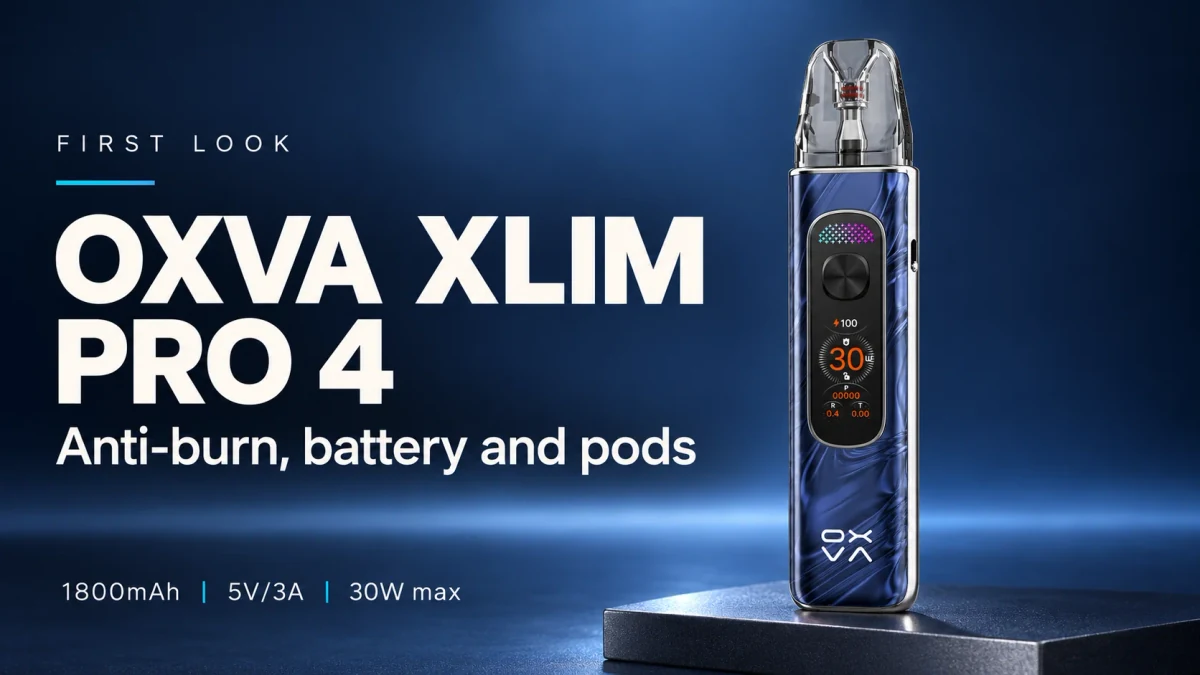
Editorial image based on product renders; screen values are illustrative.
The OXVA XLIM PRO 4 kit adds Anti-Burn Tech, an 1800mAh battery and 5V/3A charging to a familiar refillable pod format. Its most consequential detail is less obvious: an existing compatible XLIM pod can work in the device without enabling its new anti-burn protection.
The interesting change is what happens when liquid runs low: the device is designed to intervene and explain the interruption. That makes cartridge identification and readable alerts central to the design. This is a first look based on official documentation; flavor, endurance and protection reliability have not been independently tested here.
XLIM PRO 4 specifications at a glance
| Feature | Official specification |
|---|---|
| Output | 5–30W, adjustable wattage |
| Battery | Built-in 1800mAh |
| Charging | USB-C, 5V/3A |
| Display | 0.98-inch HD color screen |
| Activation | Auto-draw and button firing |
| Airflow | Side-mounted vertical slider |
| Size and weight | 124 × 27.4 × 17.6mm; 89g |
| Supplied pods | XLIM ABT Cartridge UNITECH 3.0, 0.6Ω and 0.8Ω |
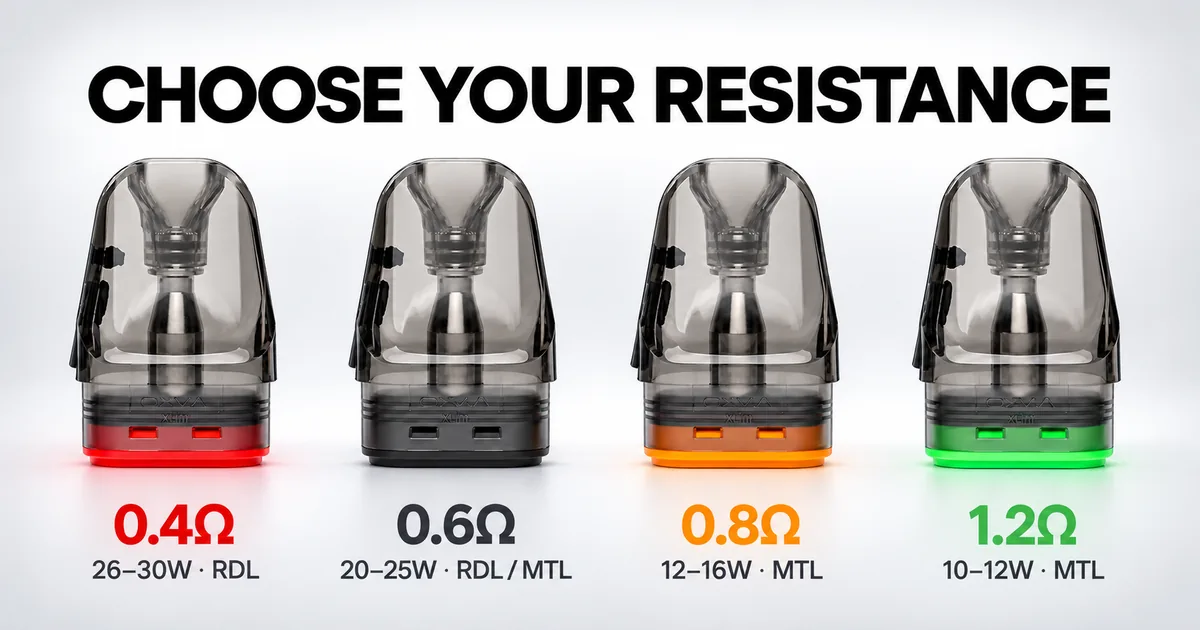
| Listed ABT resistance options | 0.4Ω, 0.6Ω, 0.8Ω and 1.2Ω |
| Pod capacity | 3mL standard; 2mL TPD version |
The dimensions, display and kit contents come from OXVA’s technical specification; the product page lists the output range and activation options.
What OXVA’s Anti-Burn Tech actually does
OXVA describes ABT as a liquid-level detection system. With an ABT cartridge installed and protection enabled, the device is designed to stop output and show a refill prompt when liquid falls below the detection threshold. The manual also confirms that the protection can be disabled.
That describes a specific safeguard against low-liquid dry hits. It does not establish that a cartridge cannot deteriorate, that every burnt taste has been eliminated, or that maintenance becomes unnecessary. The manual still calls for at least 30 seconds of priming after filling a new cartridge.
I find this a more meaningful design change than additional screen animations. It gives a refill warning a clear consequence: output stops. Its value will depend on whether that intervention is reliable and easy to understand. Detection consistency as a cartridge ages remains a practical question for testing.
Pod compatibility and ABT compatibility are different
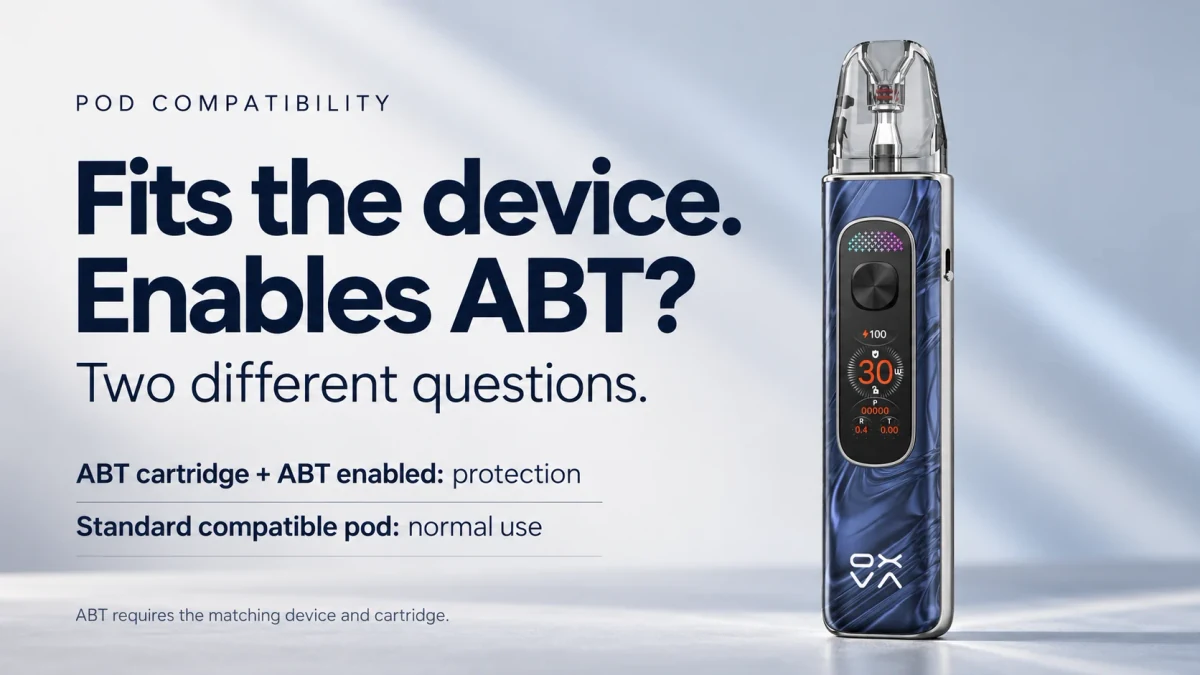
OXVA explicitly separates normal cartridge use from ABT operation. Its compatibility guidance says that standard compatible XLIM cartridges work without anti-burn protection; ABT needs a supporting device and an ABT cartridge together.
| Device and cartridge combination | Normal operation | ABT protection |
|---|---|---|
| XLIM PRO 4 + XLIM ABT Cartridge UNITECH 3.0 | Yes | Available when enabled |
| XLIM PRO 4 + XLIM Top Fill Cartridge UNITECH 3.0 | Yes | No |
| XLIM PRO 4 + other compatible standard XLIM Top Fill cartridge | Yes | No |
| XLIM 4 + XLIM ABT cartridge | Yes | No; XLIM 4 is not ABT-enabled |
UNITECH 3.0 does not automatically mean ABT. OXVA uses the UNITECH 3.0 name on both the ABT cartridge and its standard Top Fill cartridge. It describes the cartridge technology; ABT identifies the additional protection capability. This is the distinction to keep in mind when reading replacement-pod packaging.
OXVA identifies ABT pods by four base contacts, an ABT marking underneath and a red silicone ring at the mouthpiece. These details are useful because a familiar cartridge shape alone does not establish protection support. The ABT cartridge listing provides a separate reference for the new cartridge family.
Backward compatibility keeps existing compatible pods usable, but it makes labeling more important. The device name on the body is no longer enough to describe the protection in use. In my view, a clear distinction between standard and ABT cartridges matters more here than a broad “XLIM compatible” claim.
Battery and charging: useful ratings, incomplete evidence
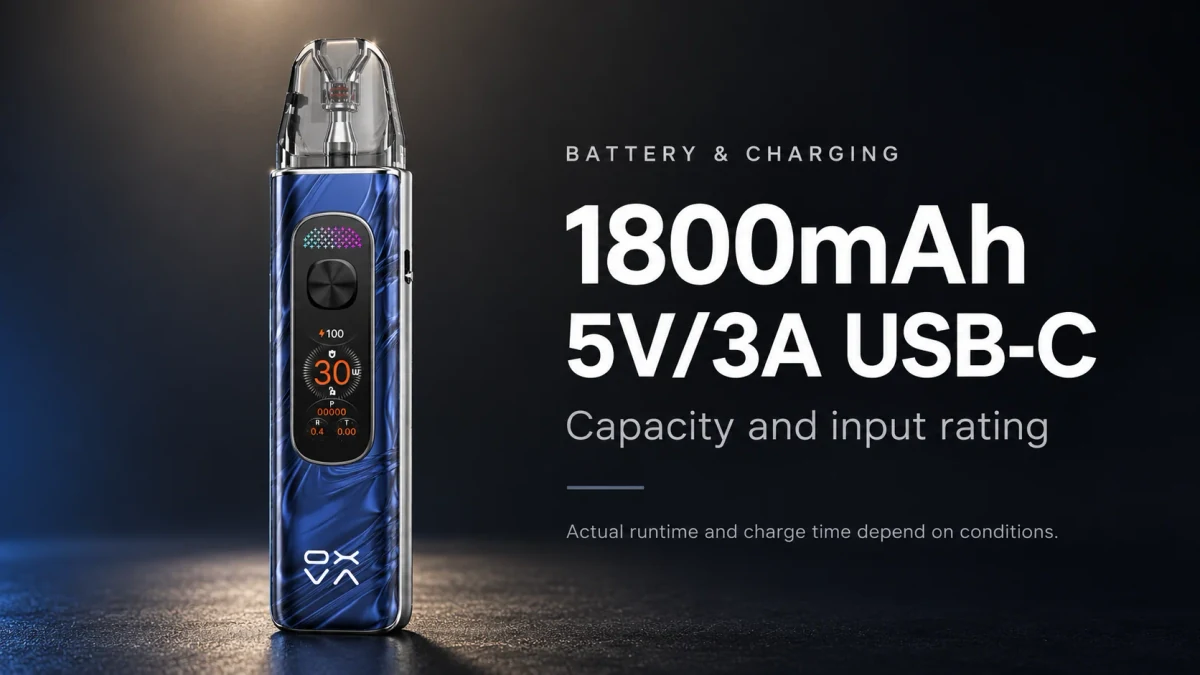
The 1800mAh rating describes nominal battery capacity. It cannot tell us how many days the device will last for an individual user. Output level, puff duration, cartridge resistance and screen use all affect the result.
The charging input is rated at 5V/3A. OXVA quotes approximately 40 minutes for a full charge with a compatible 5V/3A adapter and cable on its product FAQ. That is a manufacturer figure. Charging behavior changes during the cycle, so the input rating alone cannot establish a full-charge time.
The practical detail is the power source: the higher input rating matters only when the adapter and cable support it. The kit lists a cable, while a mains adapter is absent from the published package contents.
The screen is more useful when it explains a decision
The PRO 4 combines a display with adjustable wattage and two activation methods. That makes its interface more informative than a light alone, particularly when the device has stopped output and needs to explain why.
The strongest argument for this screen is the refill message and readable operating status. A written explanation can distinguish a refill intervention from a battery or connection problem. That makes the display part of the protection interface, with customization a secondary benefit.
The extra capability also brings more settings to understand. OXVA’s manual describes a single-button interface and a firing-button lock. A device with more settings should be judged on how clearly those controls work, rather than simply how many options appear on its feature list.
What the kit includes
OXVA lists two ABT cartridges in the kit: a pre-installed 0.6Ω pod and a separate 0.8Ω pod, plus a USB-C cable, manual and suggestion card. Standard and TPD kits use different liquid capacities, as shown on the package list.
The kit therefore provides two resistance options within the ABT family. Existing standard pods offer a separate route for normal operation, with the protection limitation explained above.
First-look verdict
The most convincing idea in the PRO 4 is the connection between detection, an explicit message and stopped output. That is a coherent reason for adding a screen and a new cartridge variant. The unresolved part is how consistently it works in use. For now, the documentation supports a clear design argument; it cannot settle the performance verdict.
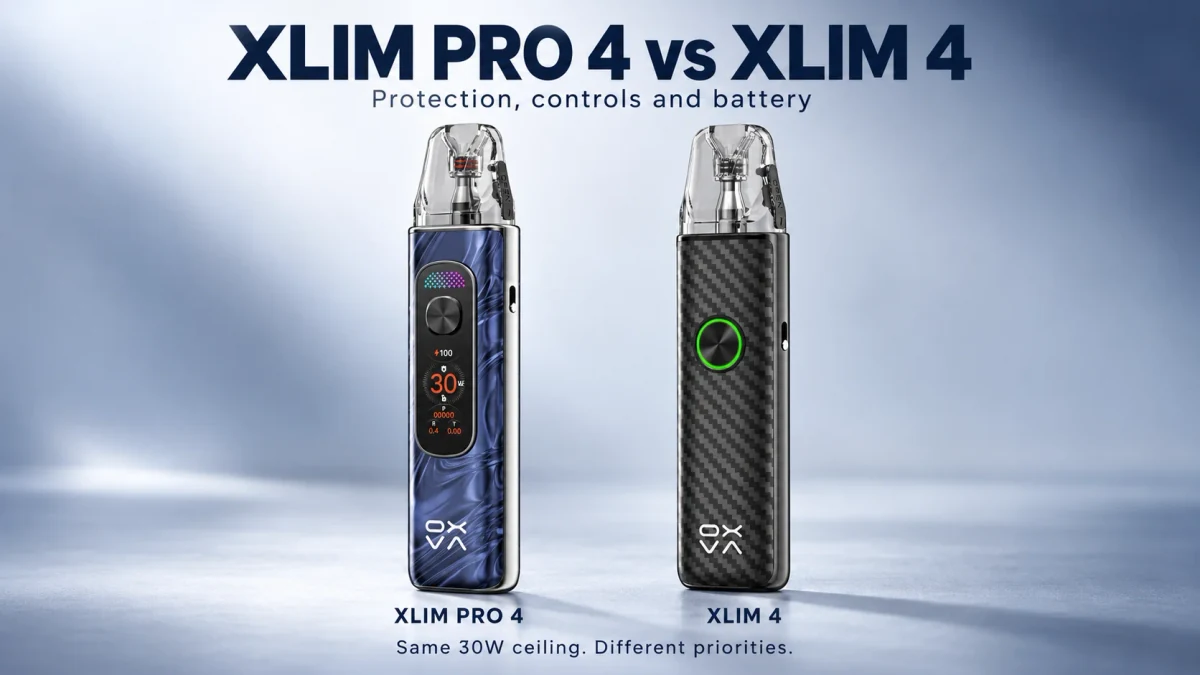
For the differences in everyday controls and physical size, see our XLIM PRO 4 vs XLIM 4 comparison.
Frequently asked questions
Can the XLIM PRO 4 use existing XLIM pods?
OXVA lists existing compatible XLIM cartridges for normal operation. A standard pod does not gain ABT protection simply by being inserted into the PRO 4.
Is ABT always active?
No. It requires the correct ABT cartridge and an enabled protection setting. OXVA documents an option to switch it off.
Does every UNITECH 3.0 cartridge support ABT?
No. The standard XLIM Top Fill Cartridge UNITECH 3.0 works normally without ABT. Protection requires the ABT cartridge variant, a supporting device and an enabled setting.
Sources
Official materials checked on 19 October 2026. Images are AI-assisted editorial compositions based on supplied and official renders. Display values are illustrative; these are not photographs from testing.