Editorial comparison · Specifications checked 19 October 2026
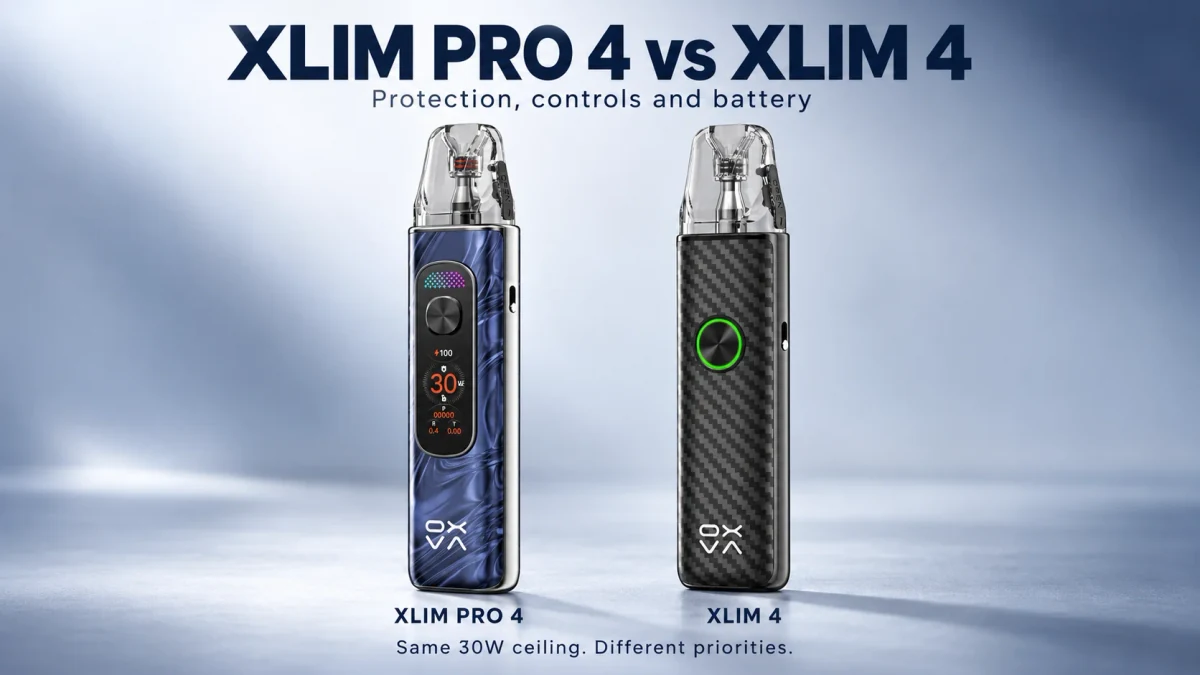
Editorial image based on product renders; screen values are illustrative.
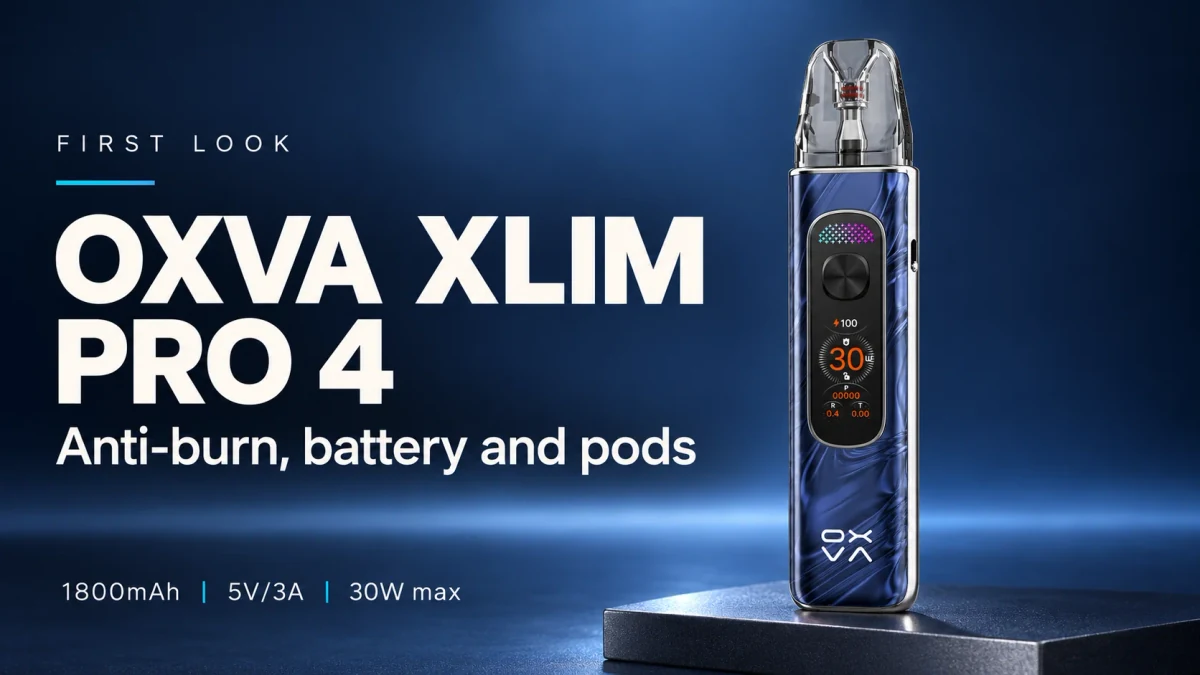
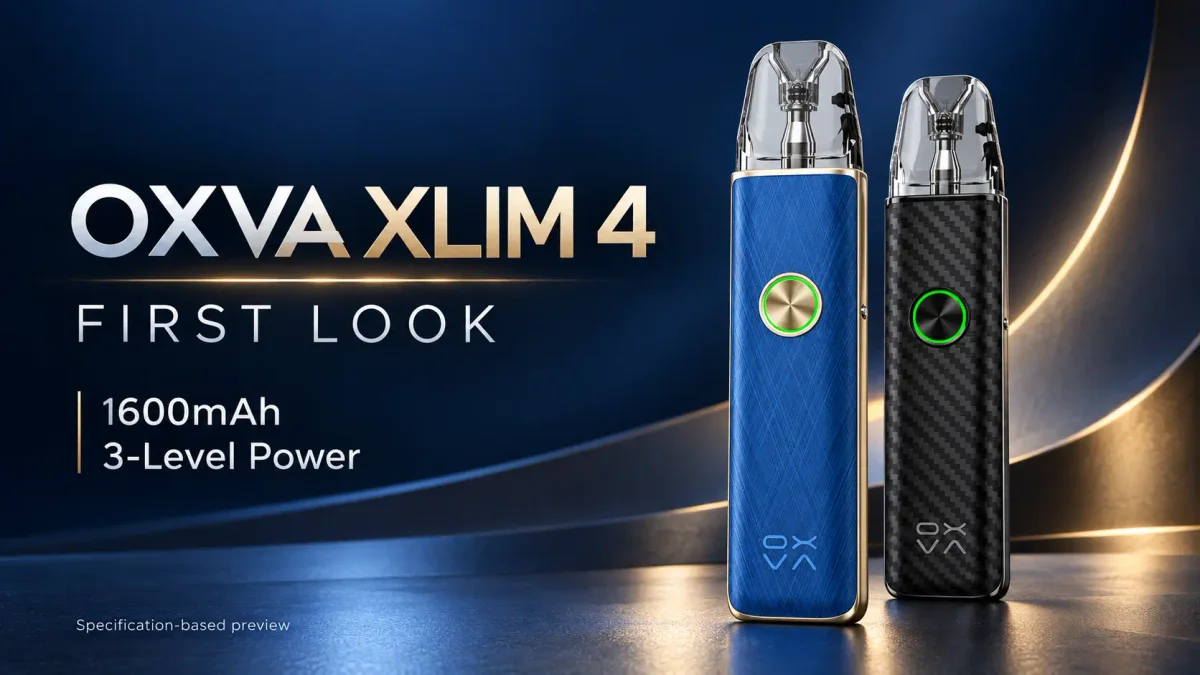
The OXVA XLIM PRO 4 and XLIM 4 both reach 30W, but they organize the experience differently. The PRO 4 adds ABT support, adjustable wattage, a color display and button firing. The XLIM 4 uses three power levels, a ring-light indicator and auto-draw firing. Its battery is smaller, and so is its body.
The meaningful differences are protection, feedback and adjustment. The PRO 4 makes more information available; the XLIM 4 reduces the number of settings to manage. This comparison uses official documentation. Flavor, endurance and protection reliability have not been independently tested here.
XLIM PRO 4 vs XLIM 4: specification table
| Feature | XLIM PRO 4 | XLIM 4 |
|---|---|---|
| Maximum output | 30W | 30W |
| Power control | Adjustable wattage | Low, Medium and High levels |
| Activation | Auto-draw or button firing | Auto-draw firing |
| Interface | 0.98-inch HD color display | Ring-light indicator; no screen |
| Physical control button | Yes | Yes |
| ABT protection | With ABT cartridge and protection enabled | Not supported |
| Battery | 1800mAh | 1600mAh |
| USB-C charging input | 5V/3A | 5V/2A |
| Dimensions, H × L × W | 124 × 27.4 × 17.6mm | 121 × 26.2 × 15.2mm |
| Listed weight | 89g | 78.1g |
| Airflow adjustment | Vertical side slider | Vertical side slider |
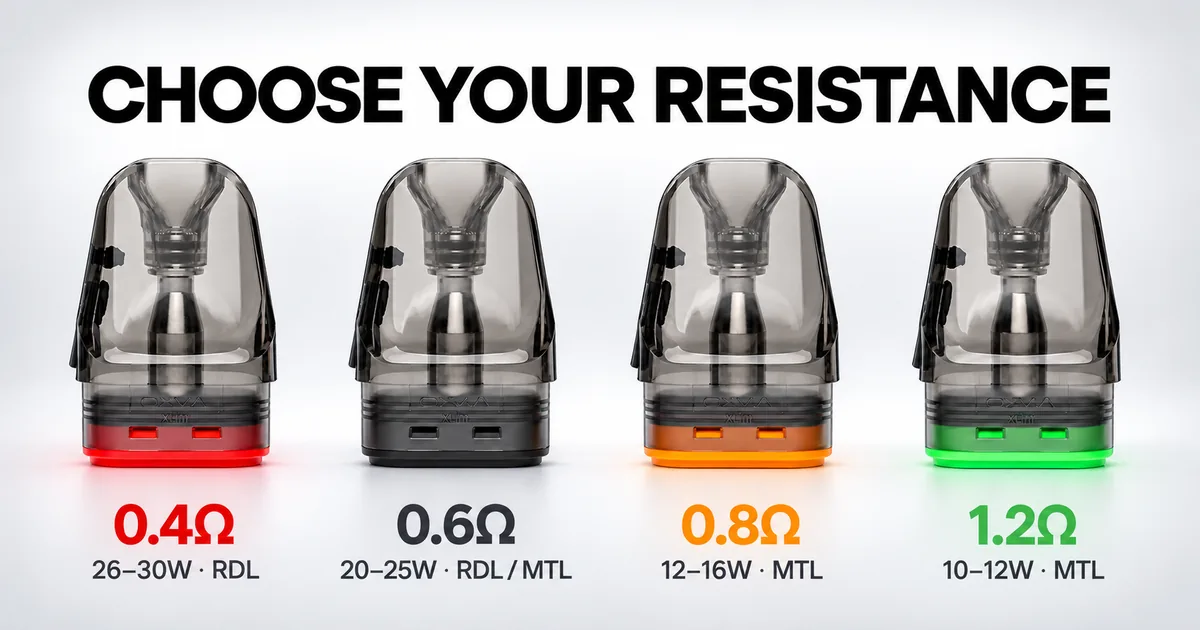
| Included cartridge resistance | ABT 0.6Ω and 0.8Ω | Standard UNITECH 3.0 0.8Ω |
| Kit pod capacity | 3mL standard / 2mL TPD | 3mL standard / 2mL TPD |
Sources: OXVA’s PRO 4 technical specification, XLIM 4 technical specification, PRO 4 manual and XLIM 4 product page.
Anti-burn protection changes the cartridge decision
ABT is the clearest functional separation. OXVA’s PRO 4 manual describes a system intended to stop output and request a refill when liquid drops below its threshold. Both an ABT-enabled device and an ABT cartridge are needed, and the setting must remain enabled.
An ABT cartridge can operate normally in XLIM 4, according to OXVA’s compatibility FAQ, but that does not add ABT to the device. The reverse limitation matters too: a standard compatible pod in PRO 4 operates without that protection.
Protection belongs to the complete setup. That matters when pods move between devices: the same ABT cartridge can operate with protection on one supporting device and without it on another. A fit check therefore answers only part of the compatibility question.
Both supplied cartridge families carry the UNITECH 3.0 name. That shared branding does not make the standard XLIM 4 pod an ABT pod. The additional protection concerns low-liquid dry hits; it does not establish a longer lifespan for every cartridge.
Controls: fine adjustment versus fewer decisions
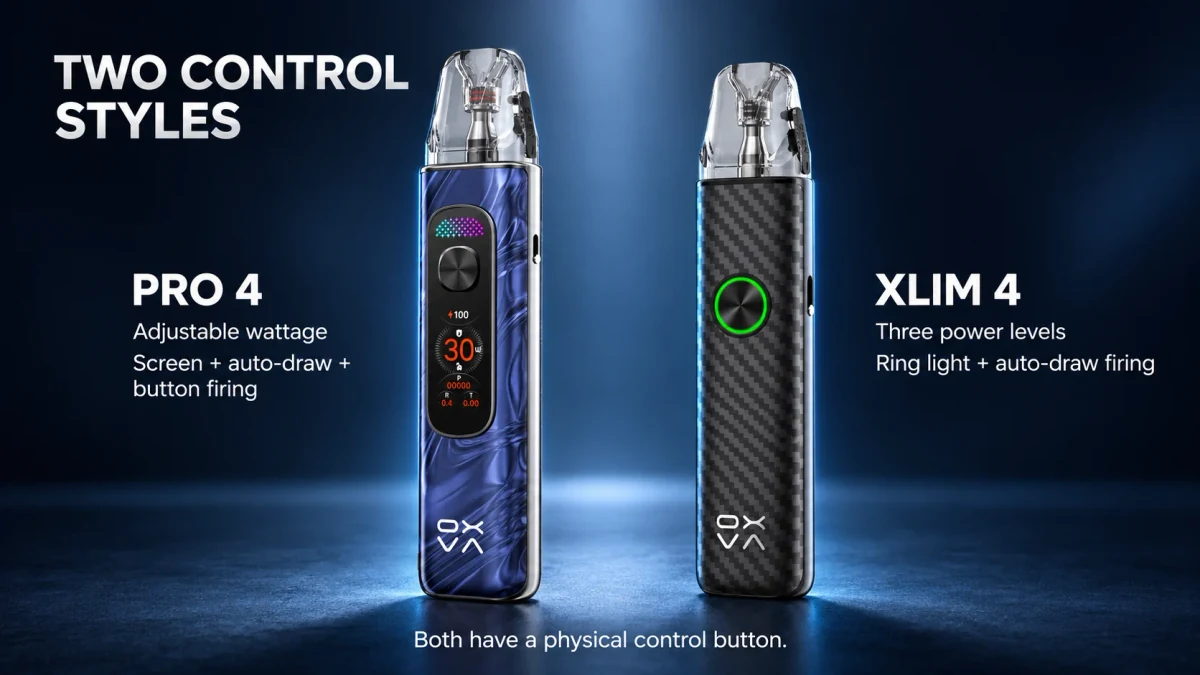
The PRO 4 provides wattage adjustment and both firing methods. The XLIM 4 is draw-activated, but it still has a physical button: double-clicking changes its three power levels. Its button controls settings rather than firing. OXVA explains the operation in the XLIM 4 manual.
These interfaces answer different needs. A numeric setting is useful when someone wants to identify and reproduce a particular output. Three levels reduce the number of choices and place more emphasis on straightforward adjustment. Neither interface alone tells us which device produces better flavor.
I regard the XLIM 4’s restraint as a coherent design choice. A screen earns its place when someone uses the extra information. For the PRO 4, the refill prompt is a stronger justification than cosmetic themes: it explains why the device has interrupted output. XLIM 4’s ring light favors quick status checks over detailed messages.
There is a learning cost either way. A single multifunction button can require remembered click sequences, even on a screenless device. Simplicity should therefore be judged by ordinary operation, rather than by the absence of a display.
Battery difference: 200mAh, or 12.5% on paper
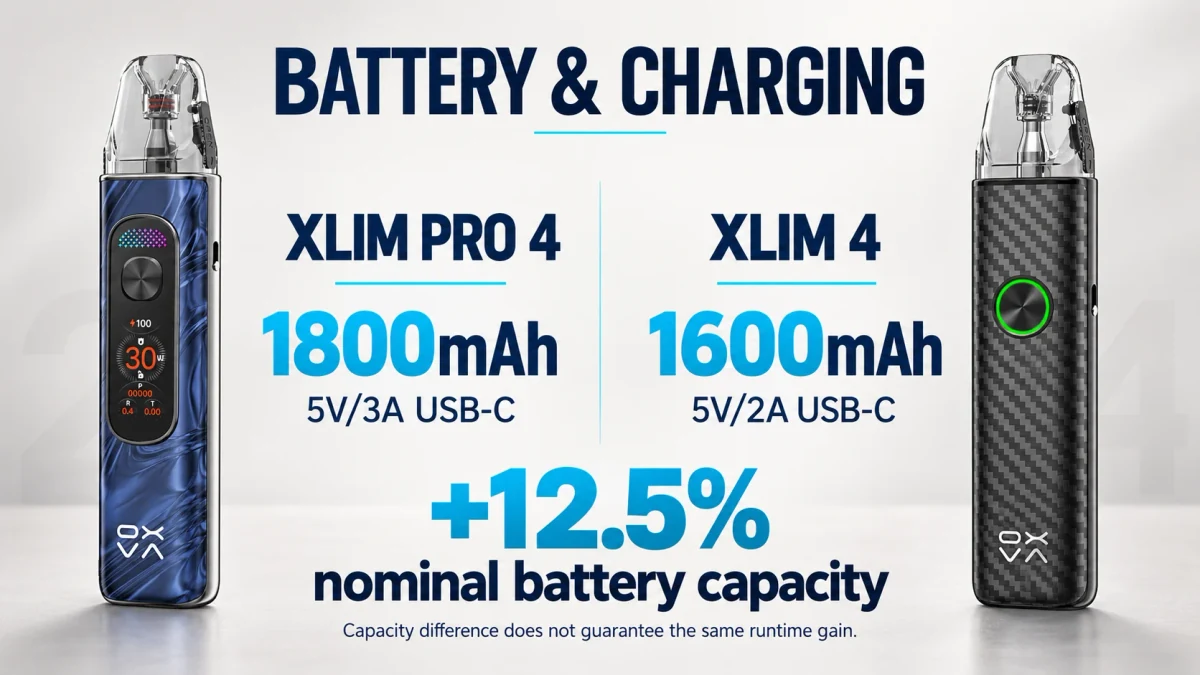
The nominal capacity difference is 200mAh. Relative to XLIM 4, the calculation is (1800 − 1600) ÷ 1600 = 12.5%.
That is a capacity comparison. Different output settings and usage can outweigh the battery difference. A matched endurance test would be needed to establish the runtime gain.
The charging inputs differ as well: 5V/3A for PRO 4 and 5V/2A for XLIM 4. Multiplying those ratings gives 15W and 10W respectively at the stated input. It does not mean the PRO 4 charges 50% faster from empty to full. Charging curves, battery size and conversion losses prevent that conclusion from following directly.
On these specifications, the battery is a supporting difference. It adds capacity without changing the 30W ceiling. The control interface and ABT support do more to explain why the two models exist alongside each other.
Size and kit contents expose the trade-off
The PRO 4 is 3mm taller, 1.2mm longer and 2.4mm thicker using OXVA’s dimension labels. Its listed weight is 10.9g higher. The largest proportional change is thickness: 17.6mm versus 15.2mm, or approximately 15.8% more.
That is why height alone is a poor shorthand for portability here. The dimensions establish a fuller body, although they cannot tell us how comfortable either device feels in hand.
There is also a kit-content difference that a battery comparison can hide. The PRO 4 includes two ABT pods, at 0.6Ω and 0.8Ω; XLIM 4 lists one standard UNITECH 3.0 0.8Ω pod. Both have standard and TPD capacity variants. The official package lists for PRO 4 and XLIM 4 confirm those details.
Editorial verdict
I would describe PRO 4 as the more configurable design and XLIM 4 as the more restrained one. The meaningful PRO additions are ABT support and a more informative, adjustable interface. The corresponding costs are more settings and a larger, heavier body.
XLIM 4 retains the same maximum output and airflow adjustment in a smaller body. Its simpler interface is a clear part of the design. I would give those differences more weight than the modest capacity gap when explaining the models’ identities.
The PRO 4’s strongest case rests on the combination of protection support and clearer feedback. Whether that translates into a better experience depends on ABT performance and the value placed on extra control. The specification sheet establishes the trade-off, rather than a universal winner.
For the cartridge details and limits of the protection claim, read the XLIM PRO 4 first look.
Frequently asked questions
Does XLIM 4 have anti-burn protection?
OXVA does not list XLIM 4 as ABT-enabled. Fitting an ABT cartridge permits normal operation, without enabling ABT protection.
Is XLIM PRO 4 more powerful than XLIM 4?
Both have a 30W maximum. PRO 4 offers finer power adjustment; that does not increase the maximum output.
Does the larger battery guarantee 12.5% longer use?
No. The figure describes nominal capacity. Matching runtime gains would need to be demonstrated under comparable conditions.
Sources
Official materials checked on 19 October 2026. Images are AI-assisted editorial compositions using genuine product renders. Display values are illustrative; they do not represent physical testing or scale drawings.