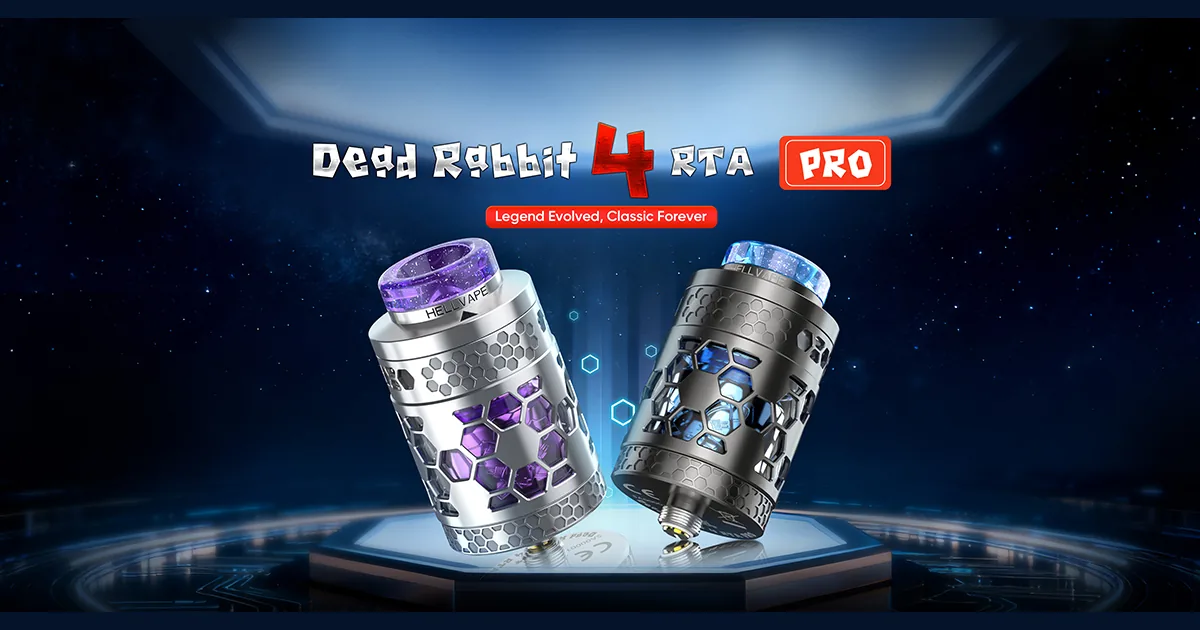
The most revealing feature of the Dead Rabbit 4 Pro is the part you can see from across the room: its metal cage. It gives the 3.5 mL straight tank section a guarded, unmistakably mechanical look. Beneath that exterior is a familiar dual-coil formula with a spacious postless deck, distributed airflow, and a sliding refill port. The interesting question is how those choices work together when you build, refill, carry, and eventually service the tank.
| At a glance | Dead Rabbit 4 Pro RTA |
|---|---|
| Format | 26 mm dual-coil rebuildable tank atomizer |
| Deck | Postless deck with 48 airflow holes |
| Airflow | Adjustable top intake; air routed down toward the coils |
| Filling | Sliding top-fill port |
| Capacity | 3.5 mL straight tube (PCTG in Hellvape’s diagram); 5.5 mL bubble glass; 2 mL version in some markets |
| Mouthpiece | Replaceable 810 drip tip |
| Distinguishing detail | Metal cage around the straight tube |

Specifications above are drawn from Hellvape’s product listing and a documented hands-on examination. Package contents and capacity can vary by region and seller; check the exact version before ordering.
The Pro’s real proposition: protection with a capacity choice
The Pro version makes its clearest statement around the tank section. Hellvape’s exploded diagram labels the factory straight tube as PCTG. The metal cage limits direct contact with the tube during ordinary handling, although the tube can still be damaged. A hands-on comparison with the standard Dead Rabbit 4 identifies that protective metalwork as the Pro version’s most visible distinction.

The 3.5 mL straight tube keeps the tank within the cage’s profile. Hellvape’s standard package illustration separately lists a spare bubble glass, which raises the stated capacity to 5.5 mL and protrudes further at the sides. The 2 mL edition is a separate regional configuration. Check which parts ship with your particular kit.
Follow the air, then judge the deck
Air enters through an adjustable ring near the top of the RTA and travels downward before reaching the build. The postless deck distributes it through 48 small openings positioned around the coil area. The goal is broad coverage across a dual-coil build, with the top intake placing the entry point above the reservoir’s lower seals. This layout can reduce one common path for liquid to escape through a low external air inlet. It does not guarantee a dry tank: sealing, fill technique, coil placement, and wick density still matter.
The hole count is less useful as a performance score than as a clue to the design. Forty-eight openings only help if both coils sit where the air reaches them and the cotton feeds them consistently. A crowded coil or poorly balanced pair can undo the promise of an elaborate air path. The roomy postless deck gives builders space to align a symmetrical dual-coil installation, though it also asks them to trim coil legs and position both coils carefully.
The sliding top-fill port is the daily convenience feature. It offers direct access for refilling without removing a screw cap. In return, it adds a moving closure and gasket that deserve a quick check when cleaning. If the top begins to seep after a refill, inspect the silicone seal, wipe the fill area, and confirm the slide is fully closed before blaming the build.
What a considered build looks like
For an experienced builder, the sensible starting point is a matched pair of coils with equal leg lengths and comparable placement on both sides of the deck. Dry-fit the chimney before final wicking so the coils do not touch the chamber, and check the final resistance on a suitable regulated device before use. The supplied-coil specification reported in a hands-on review is 0.37 Ω per coil; two equal coils installed in parallel would theoretically read about 0.185 Ω, subject to the completed build and meter tolerance. That figure is an electrical illustration, not a target for every build.
Wicking is the other half of the airflow story. Cotton should fill each coil firmly enough to maintain contact while still allowing liquid to reach the wick tails. Place the tails in their channels without compressing them into hard plugs. Start at a conservative power setting appropriate for the coils, then adjust gradually after the wick is saturated. If vapor tastes dry, inspect cotton density and liquid delivery; if liquid pools or escapes, inspect tail coverage and seals. Those symptoms have several possible causes, so one adjustment at a time makes troubleshooting easier.
This is a substantial 26 mm dual-coil RTA intended for a compatible mod and an owner comfortable with building and maintenance. Its top air path and generous deck may also suit someone who wants to tune a direct-lung draw, but neither feature replaces careful setup. Shoppers seeking a small, low-power mouth-to-lung tank should pay particular attention to the diameter, deck format, and 810 mouthpiece before choosing it.
A spare part that makes sense before you need it
If the tube is cracked or chipped at the sealing edge, stop using the tank until the damaged part is replaced. Momovaping separately lists a 3.5 mL straight replacement glass for the Hellvape Dead Rabbit 4 Pro RTA. That listing covers only the straight replacement glass. It excludes the 5.5 mL bubble glass, the RTA and O-rings. Confirm the exact atomizer model before ordering.
When fitting fresh glass, remove loose fragments safely, clean the sealing surfaces, and inspect the O-rings for cuts or displacement. Seat the tube evenly and tighten the assembly only enough to make a sound seal. Keeping the correct spare on hand is a modest ownership decision that can prevent a small accident from sidelining an otherwise serviceable rebuildable tank.
Verdict
The Dead Rabbit 4 Pro RTA is most convincing as a system: a guarded straight tube for everyday handling, a larger bubble glass for longer intervals between refills, a spacious dual-coil deck, and an air path designed to reach both coils from above. Its design rewards builders who care about alignment, wicking, and routine seal checks. If those habits are already part of your setup, the Pro’s guarded silhouette offers a genuinely useful twist on the Dead Rabbit formula.
Editorial note: This is a specification-led product analysis, not a claim of in-house flavor, leak, or durability testing. Performance varies with the build, liquid, device, and maintenance. For adults of legal age only; nicotine is addictive when present in e-liquid.