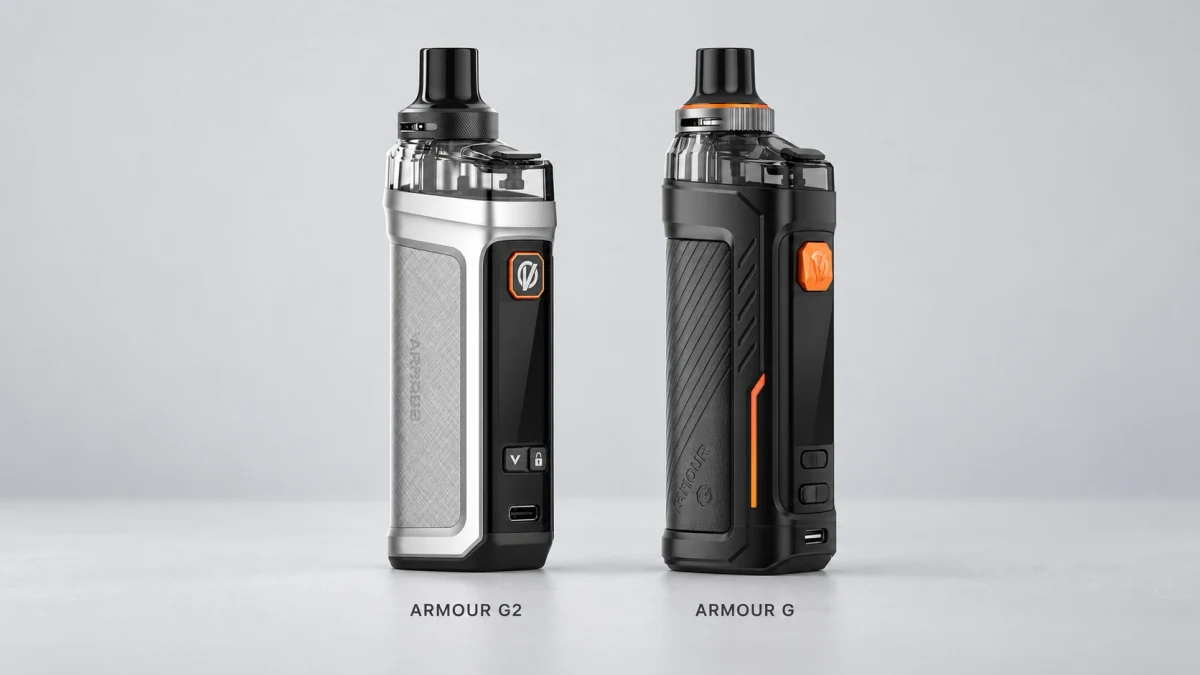
The ARMOUR G2 has a built-in 3400mAh battery and a 5–60W output range. The ARMOUR GS2 uses one replaceable 18650 battery, supplied separately, and offers 5–80W. That makes this comparison about battery ownership and supported power, rather than two different battery capacities. 1 2
My view is that the more useful distinction is how each device handles an empty or ageing battery. The G2 keeps the battery within one unit; both models have documented USB-C charging. The GS2 separates the cell from the device, allowing replacement, but also adding responsibility for selecting and looking after that cell. Neither arrangement establishes a winner for runtime without a controlled comparison.
This is a comparison of official specifications and documented features, checked on 26 October 2026. It is not a hands-on battery, flavour or durability test.
Scope and health context: This is a neutral documentation-based comparison for existing adult users, not a purchase recommendation or an endorsement of vaping. E-cigarettes are not risk-free; nicotine is addictive, and people who do not use tobacco products should not start. FDA health information.
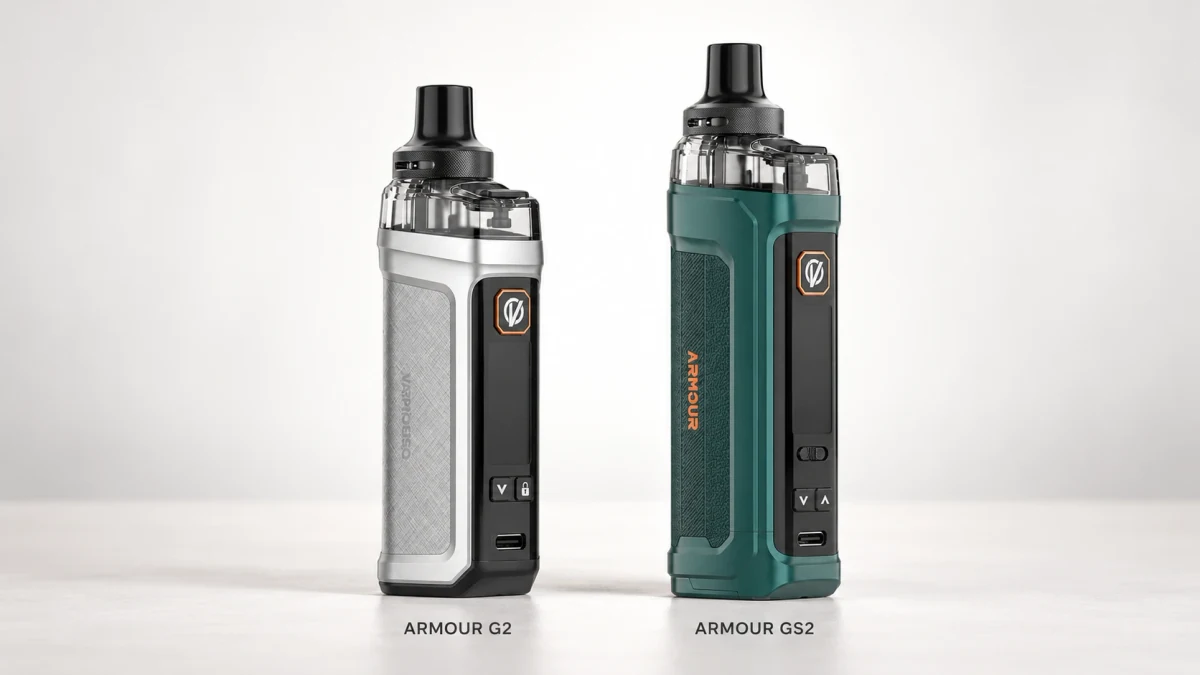
AI-generated editorial illustration based on official product renders; not a photograph or an exact hardware reference. Screens are shown switched off; the composition is not a scale drawing.
ARMOUR G2 vs GS2 specifications
| Feature | ARMOUR G2 | ARMOUR GS2 |
|---|---|---|
| Battery arrangement | Built-in 3400mAh | One replaceable 18650; not included |
| Adjustable output | 5–60W | 5–80W |
| Listed USB-C input | 5V/3A or 9V/2A | 5V/2A |
| Dimensions | 113 × 39 × 28mm | 126 × 39 × 28mm |
| Display | 0.96-inch TFT | 0.96-inch TFT |
| Global DTL kit coils | 0.4Ω Dual Mesh and 0.2Ω Dual Mesh | 0.3Ω Dual Mesh and 0.15Ω Dual Mesh |
| GTX 0.15Ω compatibility | Explicitly excluded | Supported in the documented DTL configuration |
| Lock features | Button lock and optional three-minute auto-lock | Button lock and optional three-minute auto-lock |
Sources: VAPORESSO’s G2/GS2 specifications, regional packing lists and individual product listings. 1 2 3 The global DTL kits use 5mL pods; the listed TPD DTL kits use 2mL pods. The G2 also has a separate global MTL kit. Check the actual regional version rather than assuming every box has the same contents. 3
Built-in versus replaceable changes the daily routine
ARMOUR G2: one unit to recharge
With the G2, the battery remains inside the device during normal use. There is no separate cell to install, rotate or carry. That reduces the number of components to manage, although charging still requires access to a suitable power source.
The trade-off appears when the battery is empty or its capacity has deteriorated. There is no user-swappable 18650 to exchange. For an existing adult user who normally charges at a desk during a planned break, that may be a small inconvenience. For someone whose routine depends on exchanging cells away from a socket, it changes the workflow substantially.
I would therefore describe the G2’s battery arrangement as simpler to manage, without treating it as inherently longer-lasting or maintenance-free. Its integrated design answers a convenience question; it does not, by itself, answer a longevity question.
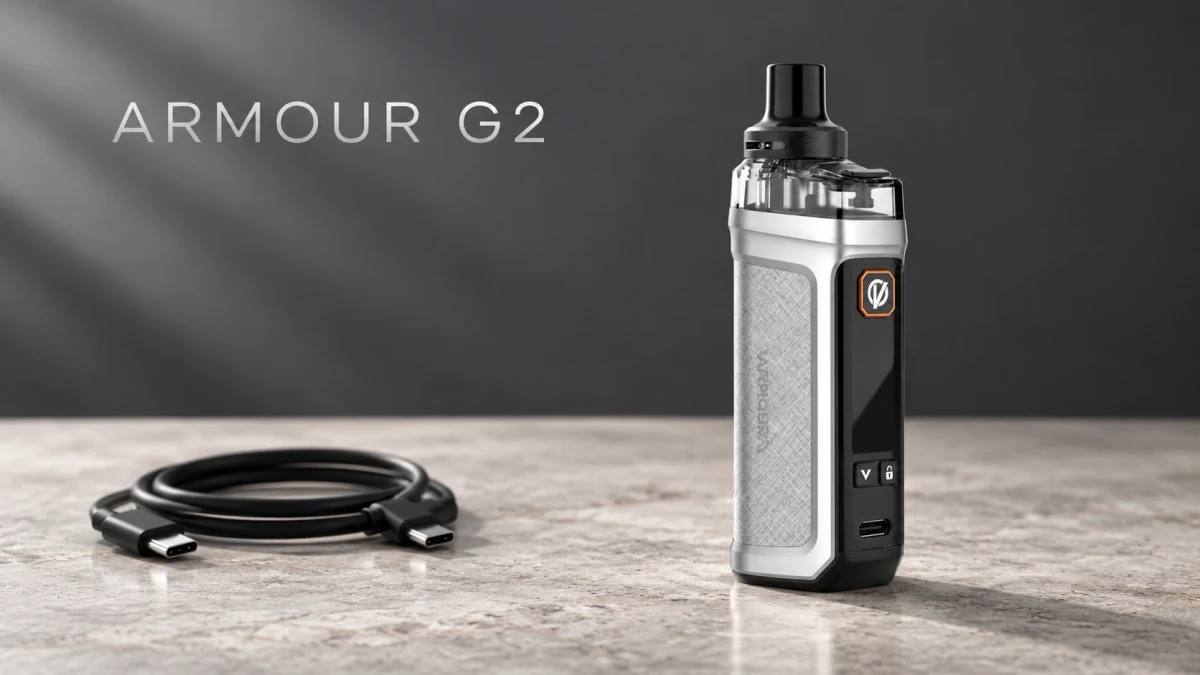
The cable is an illustrative prop. This image does not show an active charging session or document the supplied cable.
ARMOUR GS2: a cell that can be replaced independently
The GS2’s replaceable battery means a depleted cell can be exchanged for an appropriate charged one. It also means an ageing cell can be replaced without automatically retiring the device. Those are consequences of the design, rather than evidence that every GS2 will last longer than every G2.
There is a practical cost in complexity. The cell is not included, and an 18650 designation describes a format, not a universal capacity or discharge capability. Battery selection must follow the device’s requirements. Spare cells also need suitable protective storage; loose cells should not share a pocket with keys or coins. 5
For me, replaceability matters most as a way to manage interruptions and battery ageing. It should not be presented as a guarantee of longer time between charges. A GS2’s result depends on the particular cell, its condition and how the device is used.
Why 3400mAh cannot settle the runtime comparison
The G2 has a fixed published capacity. The GS2 does not have one fixed mAh figure because the installed 18650 is supplied separately. Comparing “3400mAh versus 18650” therefore mixes capacity with battery format.
A useful runtime test would hold the coil, power setting, airflow and puff pattern constant, and identify the exact GS2 cell. It would also account for battery condition and device cutoff behaviour. Testing one device at 30W and the other at 75W would describe two different workloads, rather than isolate battery performance.
This is why I would not infer an all-day winner from the specification sheet. The G2 provides a known nominal capacity; the GS2 provides a replaceable energy source. Those are different benefits, and neither removes the need for measurement.
Charging: compare the complete input rating
VAPORESSO lists 5V/3A and 9V/2A USB-C input for the G2, against 5V/2A for the GS2. 1 2 The higher listed input capability is a meaningful difference, but “3A versus 2A” is not enough to calculate a percentage reduction in charging time.
Voltage matters, and charging current does not remain at its maximum throughout a full charge. Adapter support, the cable, temperature, starting charge level and the battery itself also affect the result. These are input specifications, not measurements of constant power entering the cell.
The distinction I would keep in mind is that the G2’s higher listed input capability is relevant when a suitable power source is available; the actual time saved has not been measured here. The GS2’s replaceable-cell arrangement addresses a different interruption: an empty battery when waiting for a recharge is inconvenient. A bench test would be needed to quantify either advantage.
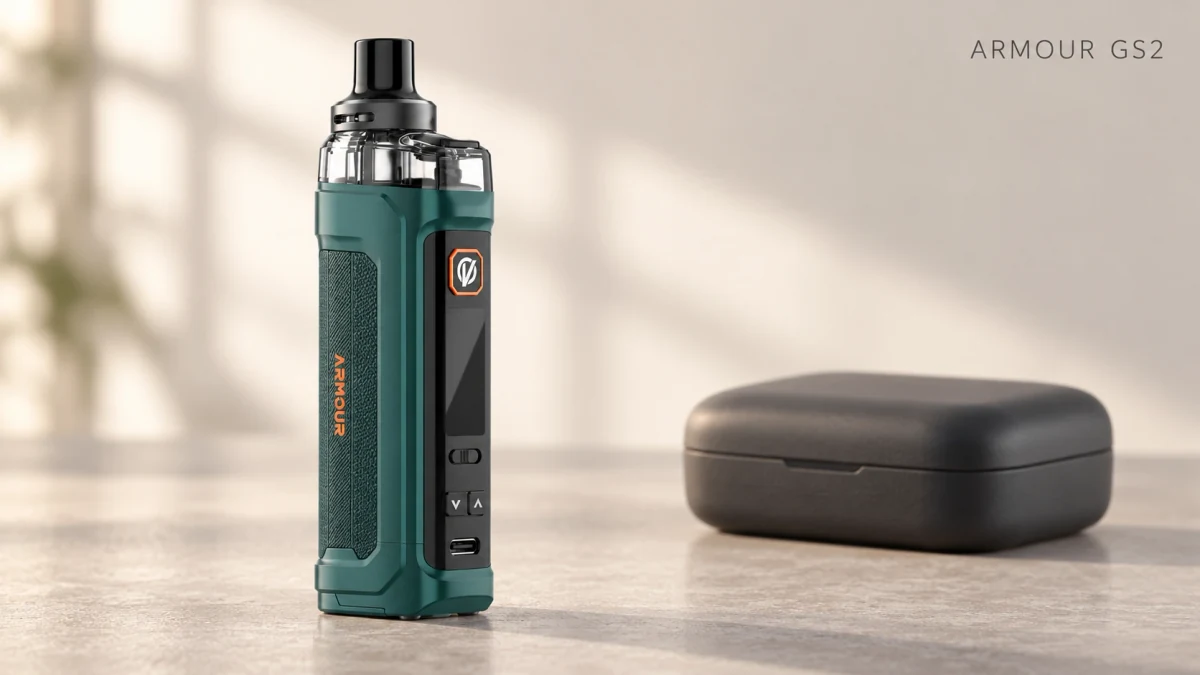
The closed case illustrates protected battery storage. It is a generic prop, not a documented kit accessory; no cell or internal battery compartment is shown.
The 60W ceiling also changes GTX coil compatibility
Both devices belong to the ARMOUR G Series pod and GTX coil ecosystem. That shared name does not make every coil suitable for both bodies.
The important exception is explicit: VAPORESSO excludes 0.15Ω coils from ARMOUR G2 compatibility. The GS2’s documented kit includes a 0.15Ω Dual Mesh coil. 2 3 This restriction should take priority over a broad family-level coil list.
It is also a useful example of why matching a wattage number is insufficient. VAPORESSO lists a 60–75W range for its GTX 0.15Ω Mesh and Dual Mesh options. The lower endpoint overlaps the G2’s maximum, but that overlap does not override the manufacturer’s exclusion. 4
The supplied coil pair is a separate question from the full compatibility list. G2 global MTL, G2 DTL and GS2 DTL packages contain different pairs. A shared platform describes an ecosystem; the device, pod version and exact coil determine the supported combination.
Size and controls deserve a careful reading
The GS2 is 13mm taller, while the published width and depth match the G2. 1 2 That is a clearer portability difference than treating either device as universally “pocket-friendly.” Shape preferences remain personal, and the GS2’s separate cell and any spare-cell case add context to what someone carries.
VAPORESSO also lists weights of 222g for G2 and 214g for GS2, but the cited tables do not clearly state a consistent installed-cell basis. I would not use that eight-gram difference to declare the GS2 lighter in a ready-to-use comparison. Both would need to be weighed in equivalent configurations.
Both models offer a button lock and an optional auto-lock after three minutes of inactivity. 1 These are useful documented controls, but their presence does not prove accidental activation is impossible.
My assessment
The battery format has the more persistent effect on ownership: it determines how an empty or worn battery is handled. The extra 20W on GS2 matters when a supported coil configuration needs that operating range. At a shared setting comfortably below 60W, an unused 80W ceiling is not evidence of better flavour or efficiency.
That is the distinction I would retain from this comparison: G2 integrates the battery; GS2 makes it replaceable. Runtime remains a test result, and coil support remains a device-specific requirement.
For the generational changes within the built-in-battery line, see ARMOUR G2 vs ARMOUR G: battery, power and GTX coil differences.
Frequently asked questions
Does ARMOUR G2 use an 18650 battery?
It has a built-in 3400mAh battery. It is not designed around a user-replaceable 18650. 1
Is a battery included with ARMOUR GS2?
No. VAPORESSO specifies one 18650 battery, not included. 2
Can ARMOUR G2 use a GTX 0.15Ω coil at 60W?
No. The official G2 compatibility note excludes 0.15Ω coils; an overlapping wattage endpoint does not establish approval. 3
Do G2 and GS2 have the same pod capacity?
The documented global DTL kits both have 5mL pods, while their TPD DTL versions have 2mL pods. Capacity depends on the regional kit. 3
Sources
- VAPORESSO ARMOUR G2 official listing: battery, input ratings, dimensions and controls
- VAPORESSO ARMOUR GS2 official listing: separate 18650, output and kit contents
- VAPORESSO ARMOUR G2/GS2 product page: compatibility exception and regional packing lists
- VAPORESSO GTX coil listing: exact coil variants and marked power ranges
- FDA: protecting loose vape batteries from contact with metal objects