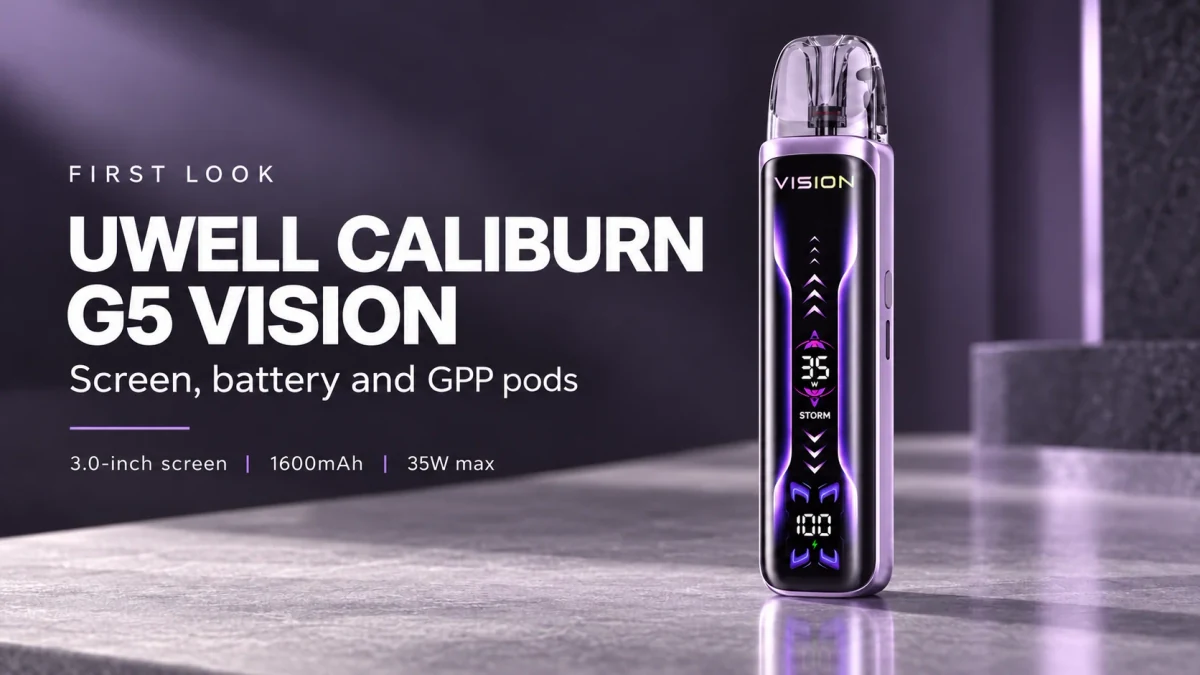
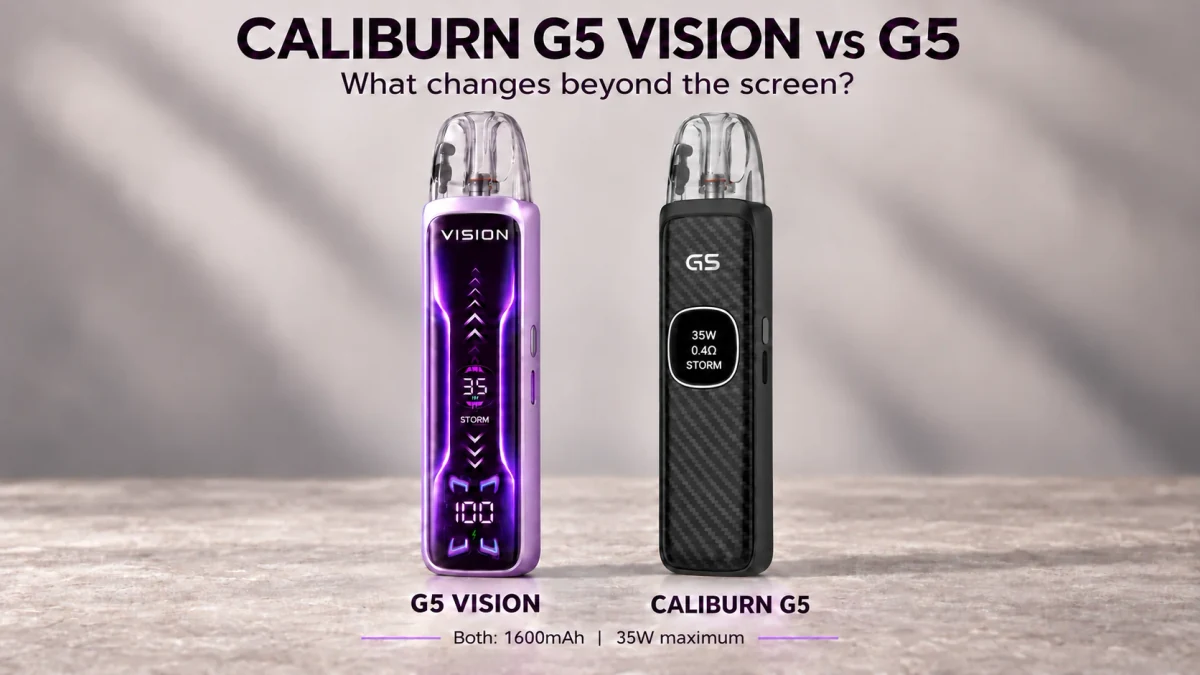
The CALIBURN G5 PRO and G5 VISION share a 35W ceiling and the GPP cartridge platform. Their main difference is how they present and control that hardware: the PRO adds a 2.79-inch touchscreen, while the VISION uses a larger, 3.0-inch display with button-based settings documented in its manual. 1 2 3 4
My view is that the PRO is primarily an interface upgrade. It also has a larger battery, but that comes with considerably more weight. Calling it a straightforward replacement for the VISION overlooks the strongest reason to retain the lighter model.
Independent comparison of official product pages, UWELL’s product information sheet and the VISION manual, checked on 2 November 2026. No hands-on performance testing is claimed.
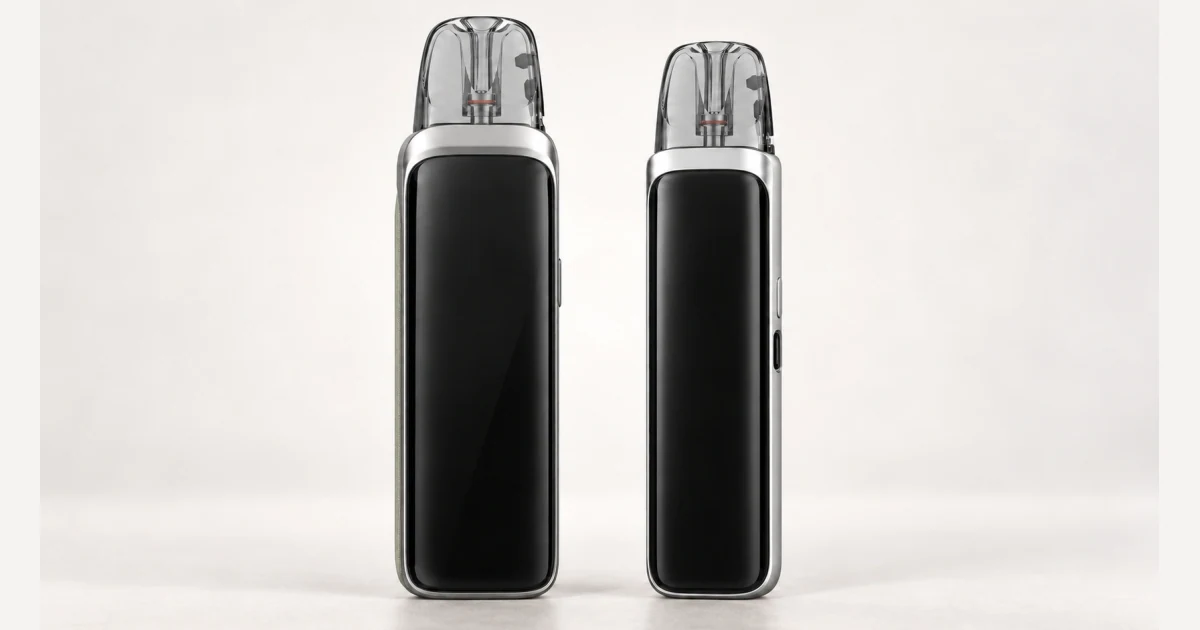
AI-generated editorial reconstruction based on official reference images, not a product photograph. PRO left, VISION right. Displays are off; this is not a screen-interface or scale demonstration.
The specifications that separate them
| Feature | CALIBURN G5 PRO | CALIBURN G5 VISION |
|---|---|---|
| Display | 2.79-inch HD touchscreen | 3.0-inch full-screen display |
| Main settings interface | Touch control panel | Physical button |
| Maximum output | 35W | 35W |
| Battery | 1800mAh | 1600mAh |
| Published charging input | USB-C, 5V/2.5A | USB-C, 5V/2A |
| Published net weight | Approximately 85g | 50.4g |
| Dimensions, selected 3 mL versions | 122.15 × 30.2 × 18.8 mm, INT. | 118.89 × 28.3 × 18.64 mm, TY |
| Cartridge platform | GPP | GPP |
The VISION weight in this table follows the 50.4g listed in its downloadable manual. An earlier specification graphic was cited as approximately 52.3g in our G5 comparison; the text in the current image is unreadable, so the discrepancy remains unresolved.
Dimensions are shown as height × width × depth. Regional cartridges change overall height: the VISION manual lists 116.14 mm for TPD/CRC, while the PRO’s regional specifications also vary. The figures above should not be applied indiscriminately to every package. 2 4
A larger display is not necessarily a touchscreen
This is the easiest distinction to miss. The VISION’s advertised screen diagonal is larger, but the PRO is the model explicitly equipped for touch input. Those are different specifications.
UWELL describes the PRO’s interface as a single-page control panel, opened through its floating U-icon. A separate downward-swipe area handles personalization. Its official material also shows four UI themes and configurable scrolling text. 1 2
A visible control may be easier to interpret than a remembered button sequence. That is a design judgment, not a measured finding about touch accuracy or speed.
The extra visual functions are less compelling to me than the panel itself. Greetings, themes and scrolling messages can establish a style; they do not establish better heating performance. The useful test is whether the interface makes an ordinary adjustment easier to understand.
For an owner who rarely changes settings, touch control may solve very little.
The VISION still has meaningful controls
The current downloadable VISION manual documents button-based mode switching and wattage adjustment. It also lists resistance-dependent adjustment ranges, so describing the VISION as a fixed-output device with a decorative screen would be inaccurate. 4
That matters to the comparison. The choice is not “adjustable PRO versus unadjustable VISION.” It is a touch-led control layout versus a button-led one.
There is a documentation discrepancy worth preserving: the VISION overview describes switching modes through repeated cartridge insertion/removal, while its downloadable manual describes button operation. This comparison uses the manual for the control assessment; owners should follow the instructions supplied with their particular unit. 3 4
The conflicting instructions prevent a confident usability conclusion without checking the particular unit.
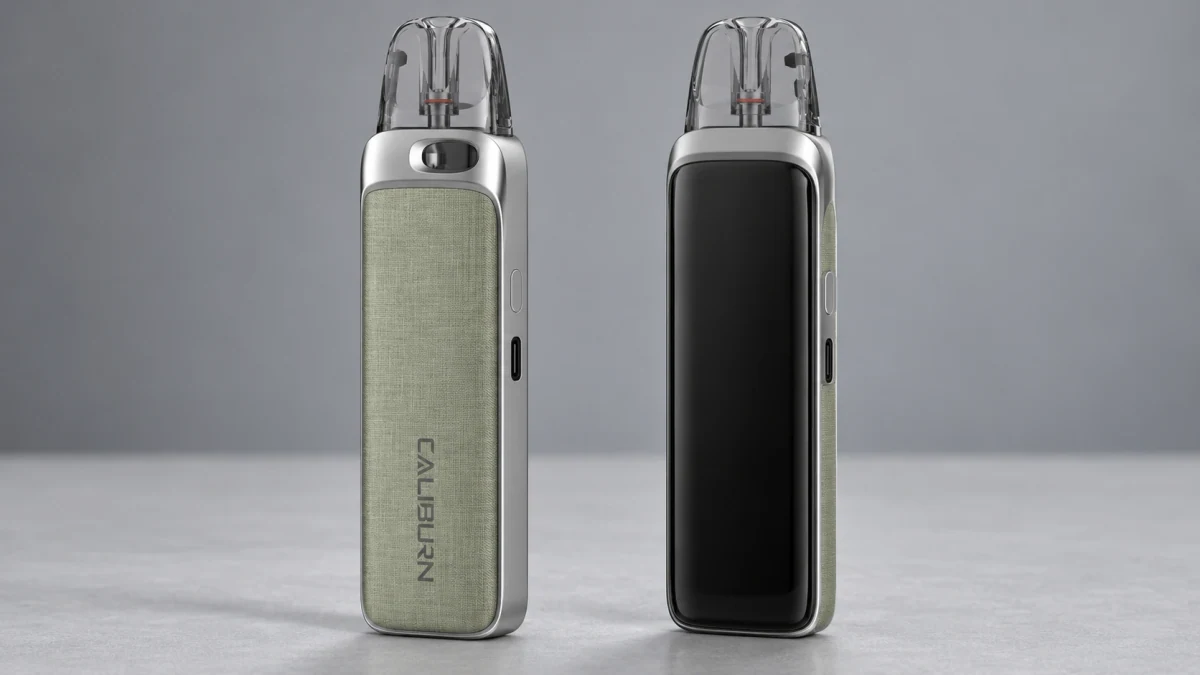
AI-generated editorial reconstruction, not a product photograph: front and rear views of the same PRO finish. This does not represent a two-device package or verify fine construction details.
Battery capacity rises modestly; weight rises more substantially
The PRO adds 200mAh, a 12.5% increase in nominal capacity. Its published weight is approximately 34.6g higher. These are calculations from the manufacturer’s specifications, not measured endurance results. 2 4
For me, that is the central practical tradeoff. The PRO asks the owner to carry a more substantial device in return for its interface, finish and additional capacity. The VISION retains a clear advantage where low carried weight matters.
It would be misleading to convert that 12.5% into an identical runtime gain. Display behavior, operating settings and draw patterns prevent a capacity comparison from settling endurance by itself. The brands’ advertised day counts are also not a controlled comparison between these two devices.
The charging inputs need similar restraint. The PRO’s higher current rating is a specification; it does not, on its own, establish a particular full-charge time.
Shared GPP compatibility changes the upgrade argument
UWELL explicitly states that both devices accept GPP cartridges. Its PRO information sheet illustrates GPP Alpha, standard GPP and compatible G3 cartridge configurations within that platform. 1 2 3
| Cartridge question | What the official material establishes |
|---|---|
| Can both use the GPP platform? | Yes |
| Is GPP Alpha exclusive to the PRO? | No; the VISION also supports it |
| Which resistance options are documented? | 0.4Ω, 0.6Ω, 0.9Ω and 1.2Ω |
| Does a shared platform mean identical kit contents? | No; fill format, capacity and supplied cartridges depend on the version |
| Does “CALIBURN” alone establish compatibility? | No; the relevant claim is for GPP-series devices and cartridges |
The practical consequence is important: an existing VISION owner does not need a PRO merely to access the shared cartridge platform.
The PRO INT. information sheet specifies 0.4Ω and 0.6Ω GPP Alpha side-refill cartridges in its 3 mL package. Other regional versions use different configurations, so a family-level compatibility statement should not replace an exact box-content check. 2
Cartridge continuity means the new interface must justify itself independently of pod compatibility.
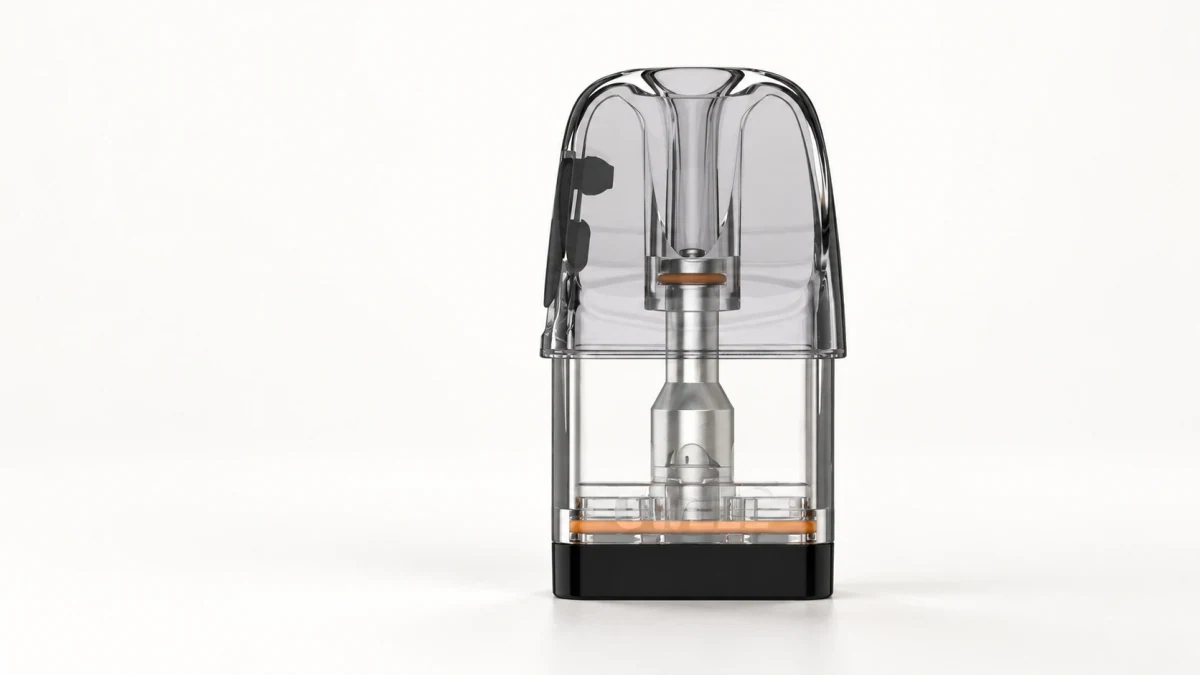
AI-generated editorial illustration of a GPP Alpha cartridge, not a product photograph or technical drawing. Confirm fit, resistance and regional capacity from the actual cartridge identification.
Style: personalization versus a racing-inspired display
The PRO’s official finish names include Gray Leather, Black Mist and Blue Palm. These names describe the available appearance; they should not be read as proof of a particular natural material. UWELL lists PCTG and PC in the PRO specifications. 1 2
To my eye, Gray Leather gives the rear panel a quieter, more restrained character than the animated front. The VISION’s racing-inspired graphics create a more assertive identity even without touch input. 3
Neither visual direction establishes finish durability. Photographs support an assessment of proportions and styling, not scratch resistance or long-term wear.
Editorial verdict
The PRO’s strongest distinction is direct access to a richer interface. The VISION’s is carrying less weight while retaining the same published output ceiling and cartridge platform.
I would treat the PRO as a different way to interact with familiar hardware. For an existing VISION owner, the meaningful question is whether touch control addresses a real limitation. Screen novelty alone is a weak reason to replace a device whose controls already work well for that owner.
Frequently asked questions
Is the G5 VISION touchscreen-controlled?
The official material advertises a 3.0-inch display, while its manual documents button controls. Touchscreen control is an explicit PRO feature. 1 3 4
Is the G5 PRO more powerful?
Both are rated at a maximum of 35W. The PRO has more nominal battery capacity, not a higher published wattage ceiling. 2 4
Can existing GPP cartridges be used with both?
UWELL confirms GPP compatibility for both. Identify the exact cartridge, resistance, fill format and regional capacity rather than relying on the CALIBURN name alone. 1 3
Does 1800mAh guarantee longer use by a fixed percentage?
No. The 12.5% figure compares nominal capacity only. It is not an independently measured runtime improvement.